
Self-Evolving Agents, Self-Improving ROI
Verified memory, governed locally, optimized for ROI.

Six months ago, most agents completed tasks.
Today, they can remain inside a continuous loop: set a goal → take action → observe the outcome → learn → act again.
Models gave agents intelligence. Tools gave them the ability to act. Goals gave them direction. Loops gave them the ability to improve.
But something critical was still missing: where does an agent’s learning live? How do we know it should be trusted?
That was the challenge behind the Self-Evolving Agents Hackathon in San Francisco: “build an autonomous agent that self-evolves in a continuous loop to achieve a goal — and takes real action. Publish, monitor, orchestrate, or transact, grounded in real sources.”
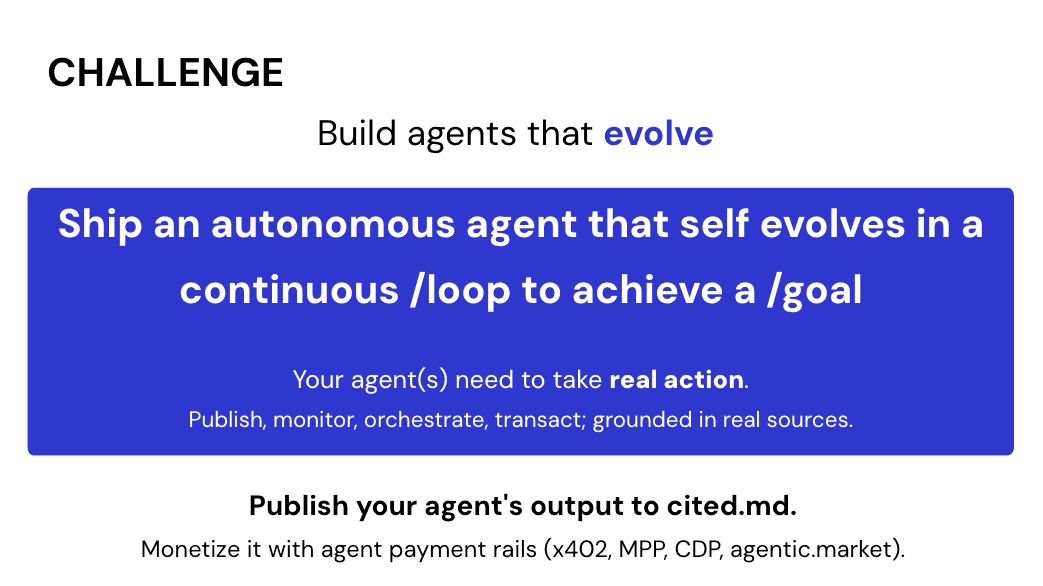
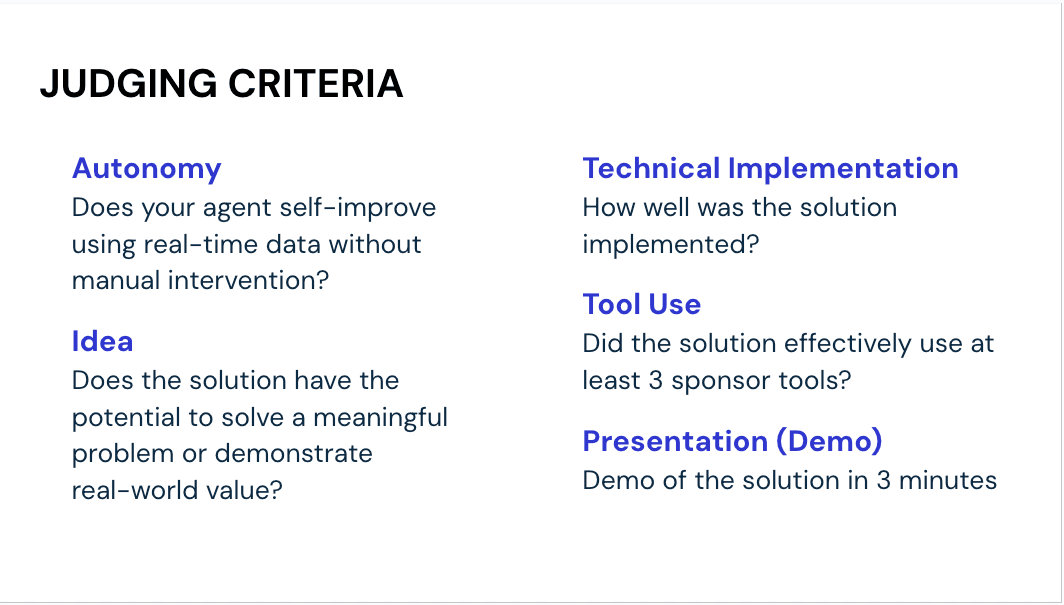
In 8 hours, 45 teams shipped working agents. Five were awarded a Senso prize: SwarmAds, Ratchet, Immune, DeUna, and Greplica.
The strongest projects — in totally different domains — independently discovered the same architecture:
The Loop: how to unlock self-improving ROI
Ingest → Evaluate → Remediate → Verify → Publish → Re-observe

Participants used Senso as verified memory for agents. Ingest a source — a policy page, a rate sheet, a repository, a conversation — and it becomes atomic, source-linked claims: single facts small enough for an agent to fetch, check, and act on, each carrying its lineage (where it came from, who verified it, when, and how often it’s been reused). A knowledge base built for agentic workflows, not for humans to search.
Nothing enters until it passes verification. Agents read from Senso before they act, write through our gate, and everything verified publishes to the surfaces agents read: your website, cited.md, MCP — where other agents fetch it, cite it, and pay to reuse it.
That gate is what unlocked self-improving ROI. Cost falls with accumulated, reusable learning. Agents that forget can’t ride the curve — they pay first-unit cost forever.
The marginal cost of a repeated outcome falls with cumulative verified usage.
What that buys you:
- Costs fall as usage rises. Every other agent system gets linearly more expensive the more you run it. This one gets cheaper.
- You never pay twice for the same problem. Solved once is solved for every future run — and for every other agent with access.
- The savings are safe to take. Nothing is kept until something proved it worked, so the cheap answer is also the checked one.
Here are some of the winning concepts built on top of the Senso platform. For each one, watch two things: what it decided to keep, and what it stopped paying for.
Ratchet: the cost of intelligence falls with use
Ratchet, built by Aayush Dixit, was a clear demonstration of self-improving ROI.
Coding agents forget everything between runs, so teams pay to fix the same bug again and again. Ratchet remembers a fix — but only after an independent test proves it worked. Same agent, same bugs, same models. The only variable was memory.
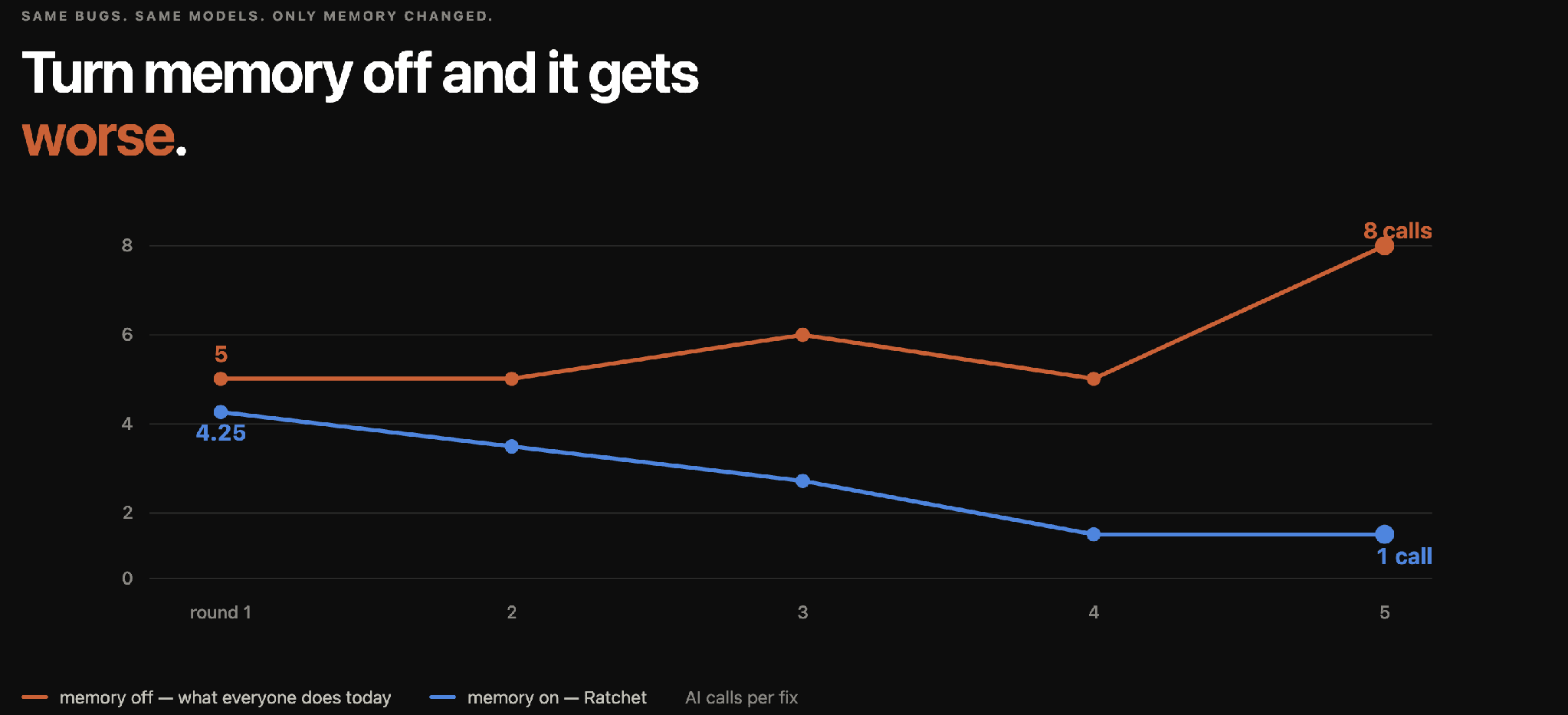
Then Ratchet pointed its memory at a different team’s app — and fixed two of the first four bugs on contact.
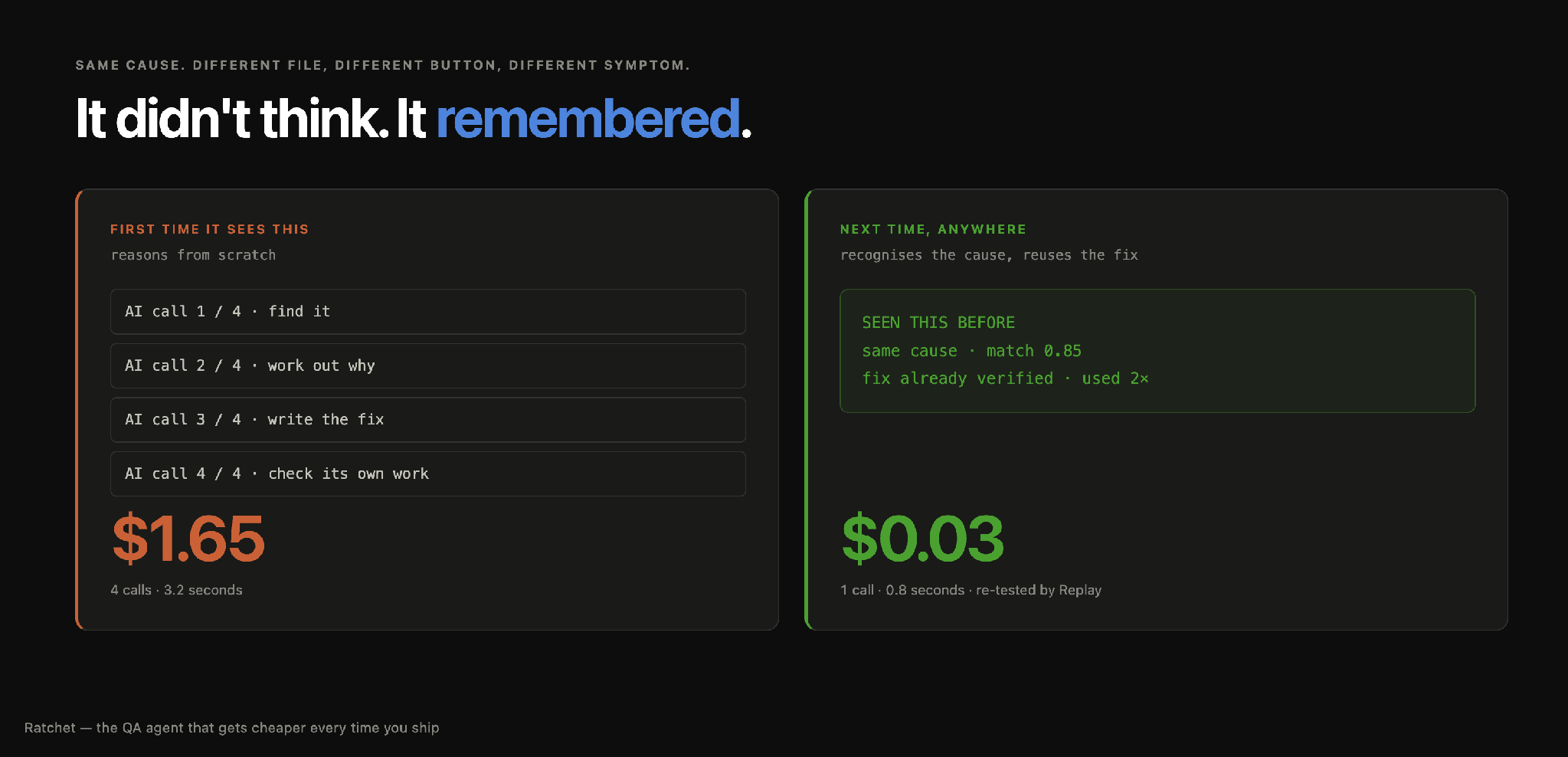
The agent didn’t become more intelligent. It stopped paying to think about something it already knew.
How they used Senso
Every proven fix is saved to Senso with its full history — who found it, who verified it, how often it’s been reused. Other agents can fetch that fix, trust it, and pay for it.
The ROI story
The same bug costs $1.65 the first time and $0.03 every time after — a 98% discount for remembering.
DeUna: one answer makes the business permanently smarter
DeUna, built by Axel Cuevas, Anthony Lee, and Andrea Urbina, is a digital twin of a small-business owner who sells through WhatsApp — his voice, his slang, his negotiation style, learned from real conversations.
When something new comes up, the agent doesn’t guess. A customer wanted to trade in a Samsung with a smashed screen; no policy existed, so the agent sent the owner three buttons: Only this one / All the same / Reject.
One tap: “All the same.” The customer got an instant answer in the owner’s voice — and every future customer gets it automatically. No re-ask. No guess. No drift.
The owner configured nothing. He answered one message, and the business became permanently smarter.
How they used Senso
Senso holds everything the agent is allowed to say — every price, policy, and promise. Each tap from the owner writes a new rule into Senso, permanently. Even the price floor lives there, so nobody can haggle the agent below it.
The ROI story
Sales close at 2 a.m. without the owner. Every question he answers once, he never answers again.
Immune: every attack strengthens the defense
Immune, built by Subhan Poudel, applied self-evolution to agent security.
When an agent gets breached by a prompt injection, Immune reads the attack trace and synthesizes a guard rule — an “antibody.” To reach production, the antibody must block the original attack, stop eight mutations of it, and leave twelve legitimate tasks untouched.
In testing, a sixth-generation attack compromised a frontier model 10 out of 10 times. Immune’s antibody blocked it 10 out of 10 times.
How they used Senso
Antibodies that survive the gauntlet are stored in Senso as versioned security records — a defense library every current and future agent inherits.
The ROI story
The ROI is the breach that never happened. Every attack survived makes the next one cheaper to stop.
From ROI to Return on Ad Spend (ROAS)
SwarmAds pointed the same loop at advertising: agents generate campaigns, test them in a simulated market, and promote only the winners into reusable memory. The agent learns which actions create revenue and puts future effort there.
The ROI story
Each generation of campaigns starts from the last generation’s winners — ROAS climbs with use instead of decaying.
Greplica proved the underlying point. Same models. Same task. Different context. Different outcomes.
How they used Senso
The team ingested a repository into Senso and benchmarked four context strategies head-to-head — Senso-native included — with context as the only variable.
The ROI story
Better context, faster fixes, same models. Context is an asset, not an input.
The next challenge: turn $2,500 into $10,000
A demo was the first step. We want funded businesses. Here’s what’s next for these amazing builders:
Each winning team gets $2,500 in Senso platform credits to keep building with Senso and the Tokens& community — with one goal: demonstrate $10,000 in customer ROI or ROAS by San Francisco Tech Week in October.
Not at the hackathon? The on-ramp is open.
Since September 2024 we’ve run 30+ hackathons in San Francisco with Tokens&, drawing more than 70,000 AI engineers. We’re happy to announce that we’re opening up this opportunity to all builders, starting today:
- Sign up — onboard at docs.senso.ai and get $100 in Senso credits.
- Prove — turn it into $1,000 of measured ROI or ROAS (simulations are acceptable).
- Payments — that result earns you an interview for a stream of additional credits to expand and grow your customer base with self-improving ROI.
- Payout — hit $10,000 in customer value and increase the odds of getting funded by top-tier Silicon Valley investors — with ROI embedded into your pitch.
Conclusion: the real meaning of self-evolution
The winning projects didn’t retrain models. They built governed memory: successful actions became verified context that could be safely reused.
That distinction matters. Truth is verified, attributable, versioned, and reversible.
The next generation of agents won’t win on intelligence alone. They’ll win on what they can safely learn, remember, and reuse.
Start Your Onboarding
Give your agent the CLI
Hand the Senso CLI to Claude Code, Cursor, or Codex and it installs the skills, ingests your sources, and starts writing verified memory on its own.
docs.senso.ai/docs/connect-your-agent →Set up your account
Create an account, get $100 in Senso credits, and start writing verified memory.
docs.senso.ai/sign-up →$ npm install -g @senso-ai/cliWe’re excited to see what you build.